There’s plenty of interest in the garden now, and here’s a selection of a few plants in flower and looking great at the moment.

Asters
Masses of long-lasting, daisy-like flowers with orange centres from August to September. Best in full sun, they are ideal for mixed borders.
 Anemones
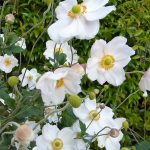
Anemone × hybrida ‘Honorine Jobert’ is a fantastic plant for brightening up the garden in late summer. It grows in sun or shade and has masses of elegant, cup-shaped, white flowers on tall, wiry stems from August to October.
 Anthemis tinctoria ‘E.C. Buxton’
This cheerful, long-flowering perennial will lift a sunny, well-drained border. It has pretty, lemon-yellow daisy-like flowers which appear throughout the summer above finely cut aromatic mid-green leaves. It has also been awarded the RHS Award of Garden Merit.
Cyclamen
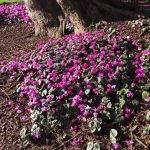
This delightful perennial provides colour often when little else is flowering, particularly in late winter or early spring. They are ideal for naturalising under trees, on banks or in a shady border. They make ideal companions for hellebores, snowdrops and other spring flowering bulbs. All have exquisite flowers and often have quite distinct fragrances, but even when not in flower, the foliage of many of these cyclamen species is outstanding.

Dahlias
Currently flowering beautifully in my hot border at the moment, Dahlia ‘Art Deco’ is an apricot-orange with a darker centre. The undersides of the petals are red – a colour which is revealed by their softly twisting form.
 Echinacea purpurea
It has pink daisy-like flowers with large, prominent cone-shaped centres. It’s perfect for growing in drifts among the border or amongst grasses and perennial prairie-style planting schemes. As a bonus, it is also extremely attractive to pollinators. The flowers are long-lived and are excellent for cutting and bringing indoors to enjoy.
 Erigeron karvinskianus
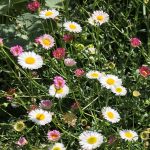
This is a low-growing perennial which has masses of small daisies with yellow centres that emerge white and then turn pink, giving this plant an unusual two-tone effect. It will flower throughout the summer and quickly spread throughout the border, often self-seeding readily. It is extremely versatile, being happy both in sun or partial shade. It has been awarded the RHS Award of Garden Merit.

Helenium’s
Helenium plants take their name from the Greek word ‘Helios’, which, when directly translated, means Sun. This robust, upright perennial looks wonderful planted in bold drifts in a sunny, moist but well-drained spot. It provides a splash of colour when many other perennials are starting to fade and is a great companion for ornamental grasses and yellow, white or earth-toned flowers. Bees and butterflies love it.
 Hesperantha coccinea (also known as Schizostylis)
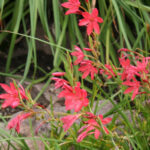
A clump forming perennial known for its late summer display of red, salmon or pink flowers that offer interest in the garden when other perennials have long lost their bloom
It has stiff, upright stems of gladiolus-like flowers above clumps of sword-shaped, mid-green leaves. It is excellent for the middle of a sheltered, sunny, moist but well-drained border. It provides vertical interest and a supply of cut flowers for use indoors.
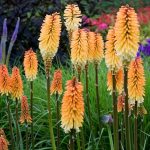 Kniphofias
Tall bright and imposing, Kniphofias lend height, vibrancy and drama to any garden. Originally from South Africa, the elegant, torch-like flowers of Kniphofia make vertical accents in a sunny border and look particularly good as an exotic scheme based on ‘hot’ colours. Kniphofia rooperi is a fantastic variety at this time of year as it continues flowering well into the autumn. It has also been awarded the RHS Award of Garden Merit.
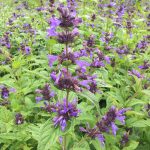
Nepeta sibirica
Lovely loose spikes of lavender-blue flowers held high above aromatic, lance-shaped leaves and flower over a long period in summer and early autumn.
 Nerine bowdenii
These exotic magenta-pink funnel-shaped flowers are still looking good whilst many other plants in the garden are beginning to fade. For best results, plant the bulbs shallowly in well-drained soil in full sun, ideally sheltered by a south or west-facing wall.

Phlomis russeliana
This has just finished flowering in my garden. I leave the seed heads on as, during the winter months, they continue to provide structure and look great with a dusting of frost. When in flower, it has whorls of hooded, pale yellow flowers which appear at intervals on tall, erect stems.
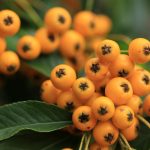 Pyracantha ‘Soleil D’or’
This a tough, hardy evergreen shrub, bearing a profusion of brightly coloured berries at this time of year. During summer, plants produce white blooms which are followed by displays of bright yellow berries, providing food for birds throughout the winter. It is tolerant of a wide range of demanding conditions, including shaded and exposed positions. It grows into a dense thorny evergreen hedge and is perfect for covering boundaries as well as training against a wall.
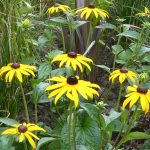 Rudbeckia fulgida var. sullivantii ‘Goldsturm’
An RHS AGM winning Black Eyed Susan which bears bright, golden-yellow, daisy-like flowers up to 12cm across, with dark button eyes that make excellent cut flowers. The radiant, coneflowers of this Rudbeckia are produced over a long period, attracting bees and butterflies to their long lasting blooms. These compact perennials are easy to grow, reliably filling gaps in borders, and returning year after year. It looks great planted in bold drifts with other late summer-flowering perennials and ornamental grasses. It copes well in a sunny spot and is ideal for the middle of a border that doesn’t dry out over the summer.
 Sedums
Succulent leaves, topped with salmon-pink flower-heads in summer, maturing to pinkish-bronze then coppery-red in autumn. This versatile perennial is a perfect filler plant for a sunny, well-drained spot. A valuable late source of nectar for butterflies and bees, the dried flower heads provide structure and colour in the winter garden.

Verbena bonariensis
This flowers over a long period and will add height without becoming too overbearing. The flowers appear in small clusters, adding splashes of colour, and this creates a very appealing lightness. The flowers will attract bees, butterflies and moths, so they are great in a wildlife garden.